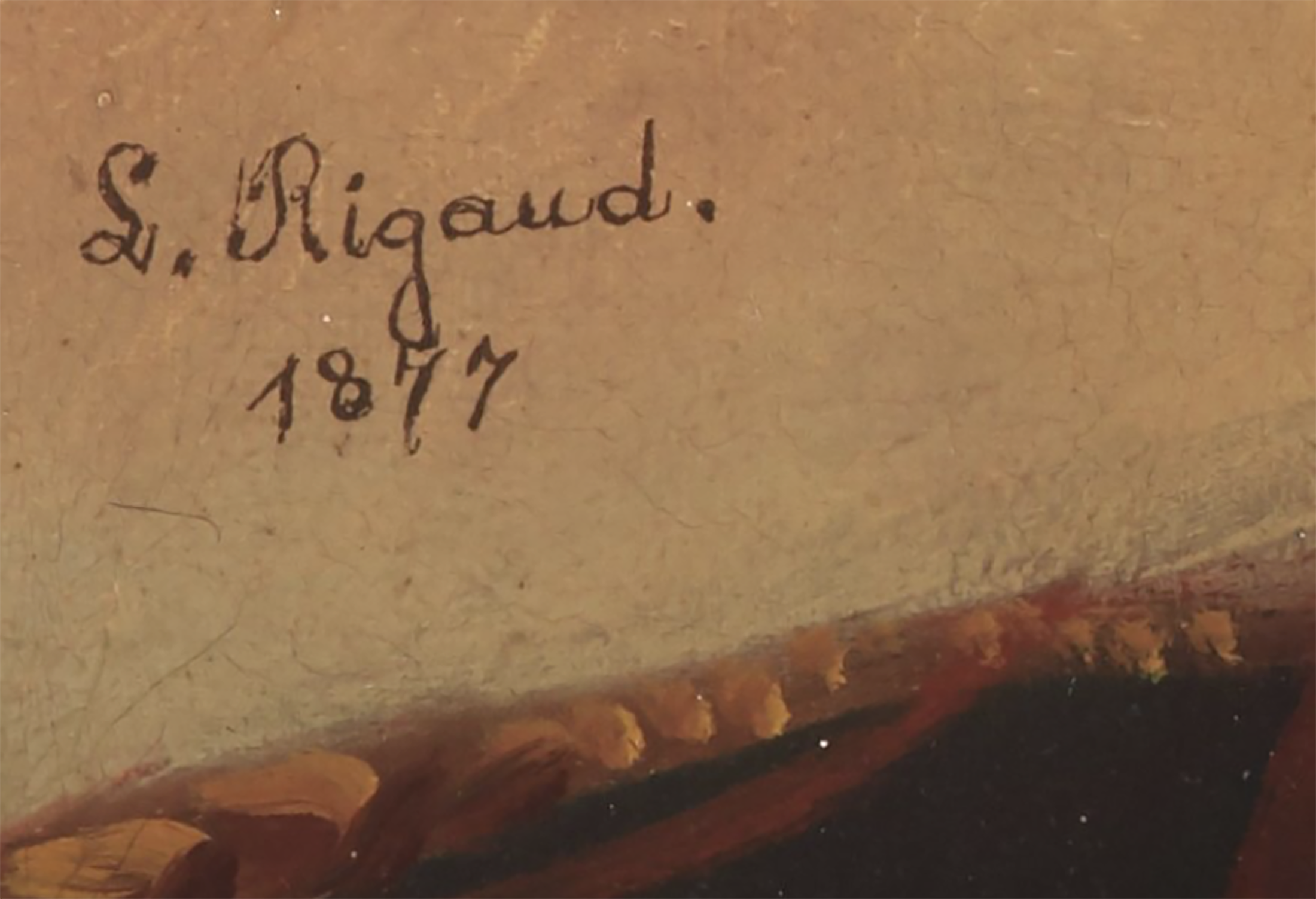
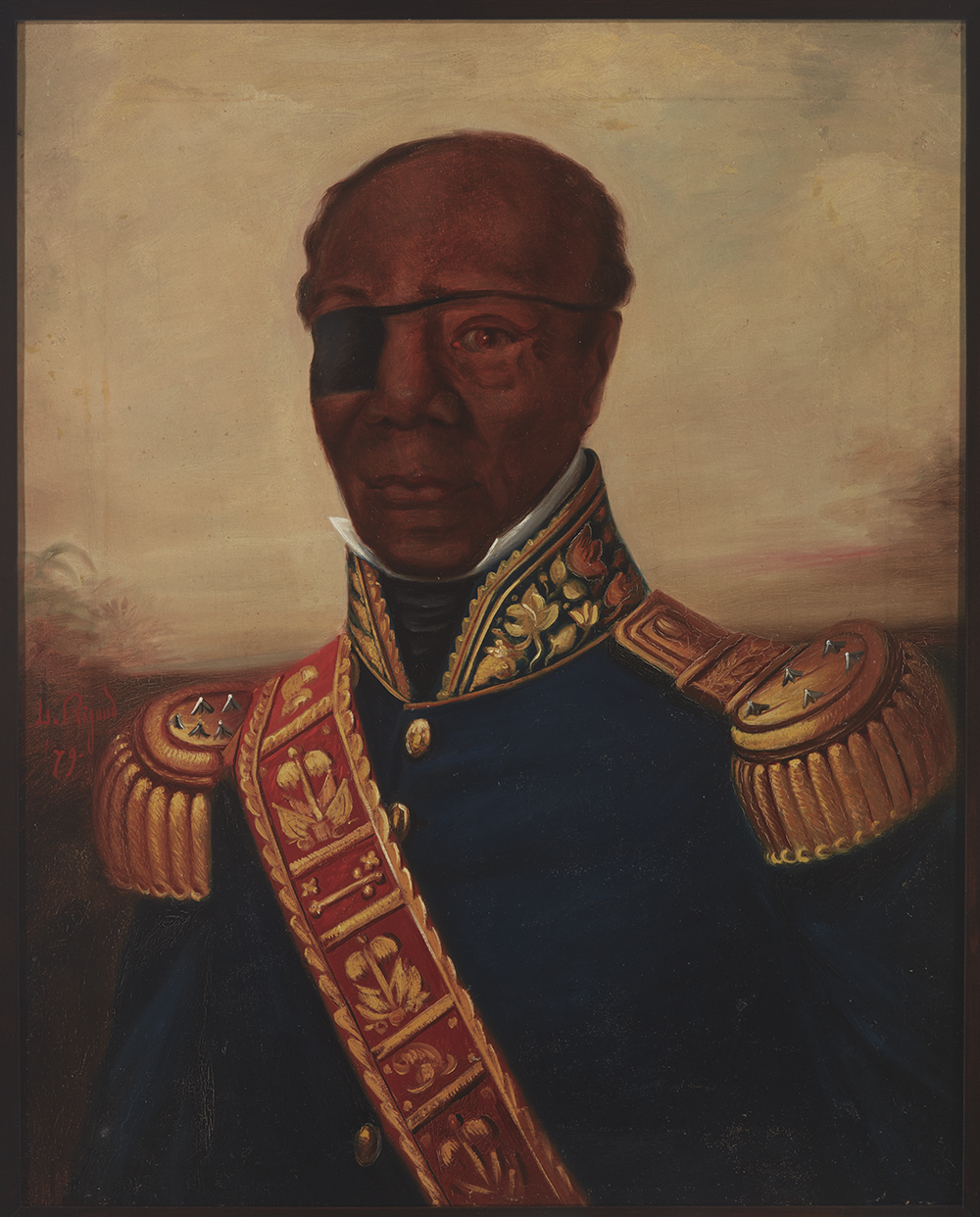
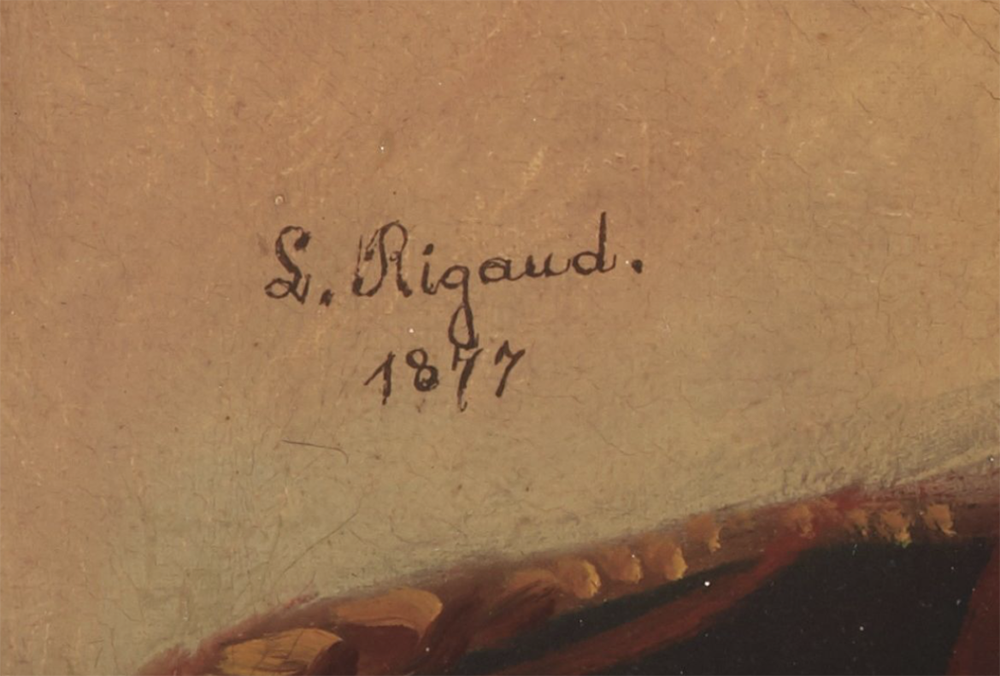
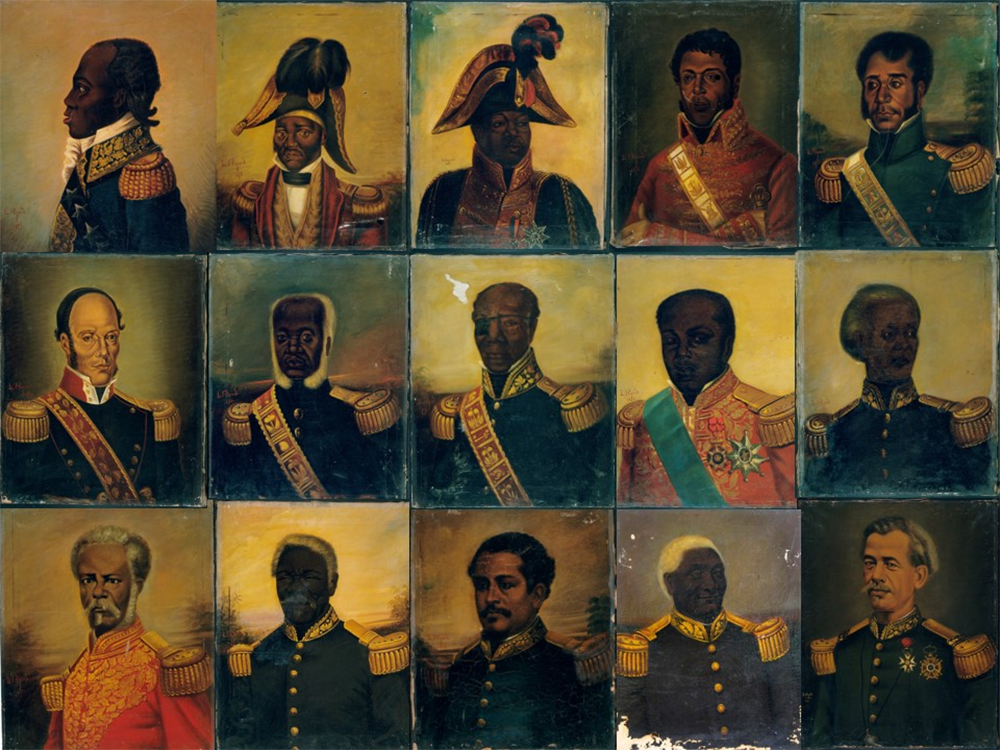
In 1963, Yale University’s Peabody Museum accessioned seventeen nineteenth-century portraits of Haitian revolutionaries, heads of state, and military figures from the United States National Museum, an entity of the Smithsonian. That same year, Saul H. Riesenberg, a curator of ethnology at the U.S. National Museum, wrote to Cornelius Osgood, curator of anthropology at the Peabody, that he “had not been able to learn anything about the painter, L. Rigaud,” whose signature appeared at the bottom of each painting. When Peabody staff later formally catalogued the paintings after five decades, they realized no one had learned much in the intervening years. Working with existing scholarship, however, staff at the Peabody came to believe the paintings were the work of Louis Rigaud.
Yet while researching the life of the painter for a forthcoming exhibit of his works—which I am co-curating at the Peabody Museum in New Haven, CT, to open this fall—not only was I unable to find any record of a Haitian painter named Louis Rigaud, but I turned up a completely different name for the artist who came to be known (erroneously) as Louis.
Finding birth and death records for the real artist who signed his name as L. Rigaud allowed me to unearth all kinds of intriguing information about his life that will be featured in our exhibit. This exhibit will mark only the second known time the suite of rare paintings—which originally included Toussaint Louverture and Haitian rulers from Jean-Jacques Dessalines to Lysius Salomon—will be displayed together. The provenance and survival of any of these paintings—from Haiti to New Orleans to Washington, DC, to New Haven (with short detours in Baltimore and northern California)—already tell quite a story. But the artist’s real name has even more to say, not only about the painter and his life, but about the uneven acceptance of historical silences, the ease with which artistic misattributions travel, and the remarkable persistence of Haitian archives in an inhospitable world.
Once in the U.S., the Rigaud paintings were debuted at the 1884-85 World’s Industrial and Cotton Centennial Exposition in New Orleans, likely in the “Colored Department.” In his letter to Osgood, Riesenberg reported that the works, which had been collected by a “Mrs. J.J. Audain,” had come to the museum “upon the closing of the New Orleans Exposition, where they had been placed by the Haitian government.” Because mid-twentieth-century curators at the National Museum and the National Portrait Gallery deemed the paintings to have neither “ethnographical” nor “artistic value,” when Yale professor of anthropology Sidney Mintz expressed interest in them in 1963, the Smithsonian had no qualms about permanently transferring the portraits to Yale in an “open exchange.” For the next two decades, the paintings bounced between the homes of Mintz and his colleague, history professor Richard Morse, before ultimately being placed in Peabody storage.
After the catastrophic January 2010 earthquake that destroyed much of Haiti’s capital, including many cultural and historical institutions, curators around the world came together to help safeguard Haitian patrimony. Around that time, Haitian art historians learned that the Peabody Museum had in its archives fifteen of the seventeen original L. Rigaud portraits (two paintings of Presidents Sylvain Salnave and Jean-Louis Pierrot are considered lost), which had not been displayed publicly since their debut in New Orleans. Following this renewed interest, Peabody curators assembled an international team of researchers and conservator-restorers, including from the State University of Haiti, to study and repair the badly damaged artworks. Soon thereafter Yale reported the existence of the portraits to the world. Relying on what turned out to be mistaken information found in late twentieth-century Haitian periodicals, however, the researchers misidentified the artist as Louis Rigaud.
How did L. Rigaud become Louis? It appears to have begun on November 13, 1980, in Port-au-Prince when Michel-Philippe Lerebours, a Haitian art historian trained at the Sorbonne, and Michèle Montas, a journalist and producer at Radio Haïti-Inter, opened a grand exhibit they had curated at the L’Institut Français en Haïti. Unveiling more than eighty previously “unknown” paintings, mostly produced before 1930, the artwork at this exposition differed greatly from the folk, landscape, and religious (Christianity and Vodou) paintings that had dominated and made world-famous Haiti’s art scene since the mid-twentieth century. In large measure, the pre-1930 paintings represented portraits of historical figures or tableaux of major events in Haitian history. Included were the works of a portraitist of Haitian heads of state whom Lerebours introduced to the audience as Louis Rigaud. The exhibition was complemented by a series of conferences beginning on November 13, as well as a roundtable moderated by Montas on November 26, featuring Lerebours, accompanied by Laurore St. Juste, former director of the National Archives of Haiti; Pierre Monosiet, curator of the Musée d’Art Haïtien du Collège St. Pierre; and the Haitian artist Simil (Emilcar Similien). Lerebours must have been gratified after one visitor proclaimed that the exhibition “has all the hallmarks of an invitation to a communion with our history…a positive element capable of provoking a rediscovery of the Haitian man.”1
Although, like the Smithsonian, Lerebours acknowledged he “did not have any information” about the painter himself, Lerebours inexplicably referred to Louis Rigaud again as the nineteenth-century artist who painted Haitian heads of state in two 1981 articles, one published in L’Institut Français en Haïti’s journal Conjonction and the other in the magazine Haïti santé. In the latter, Lerebours wrote that “the [Haitian] artist whose work we know best is Louis Rigaud.” Lerebours then revealed that Louis Rigaud was “the one commissioned to create most of the works intended to commemorate the Centenary of Independence in January 1904.”
Several years later, when Lerebours published his Sorbonne doctoral thesis as a two-volume book titled Haïti et ses peintres de 1804 à 1980, souffrances et espoirs d’un peuple (1989), he once more announced that the artist whose heads-of-state paintings appear on many pages in his own book was Louis Rigaud. A work of astonishing and unique erudition covering two centuries of Haitian art, Haïti et ses peintres quickly became the standard reference in the field. Yet, none of the cited historical sources listed in Lerebours’ extensive and otherwise impeccable footnotes in Haïti et ses peintres contain any mention of a Louis Rigaud or make any reference to such a painter at all.
Enter a Romanian graduate student named Eva Pataki, who also played a part in amplifying Lerebours’ identification of an artist named Louis Rigaud, at least in the Anglophone world. In her 1986 book, Haitian Painting: Art and Kitsch—drawn from materials she collected during research for her master’s thesis and while visiting Haiti—Pataki described numerous nineteenth-century Haitian paintings that she viewed in museums and galleries, saw in the homes of private citizens and foreign collectors, or that she learned of while participating in dialogues and conferences with art historians in Port-au-Prince. One of those art historians was Michel-Philippe Lerebours. When Pataki referenced a portrait of Haitian president François Denys Légitime’s daughter contained in the Maison Defly collection in Port-au-Prince, noting that Lerebours’ 1981 article from Conjonction “presents important facts and events,” she did not hesitate to repeat that it had been “painted around 1900 by Louis Rigaud.”
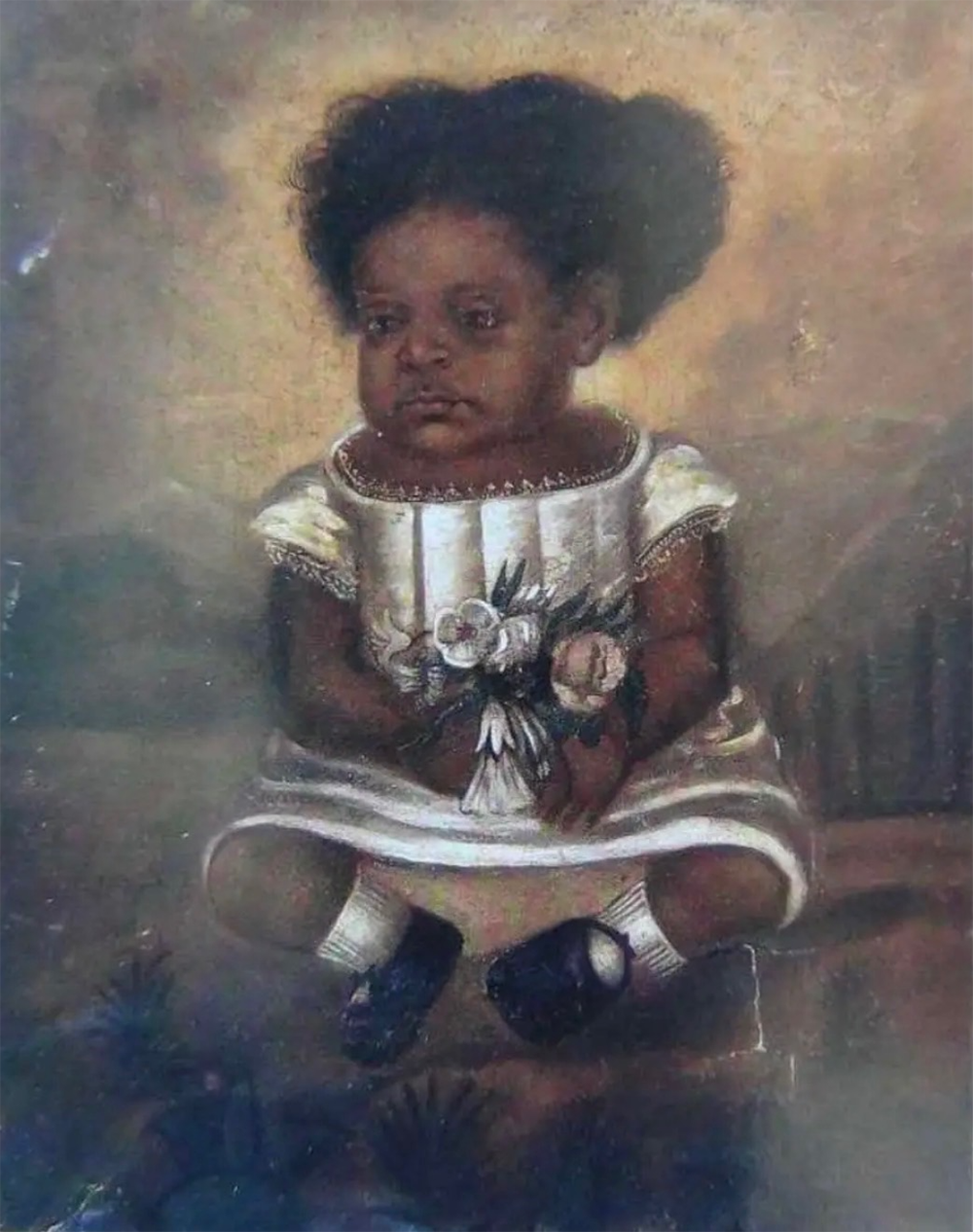
By the time Yale’s Peabody Museum took interest in restoring the Rigaud paintings in its collection, a nineteenth-century Haitian artist who painted Haitian presidents had been known in Haiti under the first name Louis for at least three decades. Thus, when the assembled team of international researchers came together to study the history and provenance of the fifteen still extant portraits in the Peabody’s collection, they naturally associated the signature L. Rigaud with the nineteenth-century Haitian painter whose first name Lerebours appears to have simply assumed was Louis. Generations of scholars interested in early Haitian art have universally accepted Lerebours’ (and the Peabody’s) assumption.
Yet as a biographer and a cultural and intellectual historian tasked with learning more about the artist behind the artwork, I was surprised to find no records of a painter named Louis Rigaud in nineteenth-century’s Haiti’s minutely detailed history books. For a such a prolific history painter whose works were so closely aligned with representing government officials and celebrating national narratives, one would expect to find at least a few notices or mentions of his artwork in Haitian newspapers, too. The absence of mentions of Louis Rigaud seemed even more curious when I considered that Lerebours indicated Rigaud had been part of an atelier in the 1880s that included such prominent figures from the Haitian art scene, as Archibald Lochard and Lominy Armand. How could all records of an artist who cavorted with well-known Haitian cultural and government figures and who was famous enough to have his paintings sent across the seas to represent Haiti at the Cotton Centennial just disappear? Was L. Rigaud truly destined to be remembered as a nineteenth-century Haitian painter whose artwork had been preserved, but whose identity had not?
Despite international inattention and relative unawareness of its existence, the Haitian past has been voluminously documented and archived at institutions inside and outside the country. In part because of wholesale foreign defamation of Haiti’s origins in a radical revolution against slavery and colonialism, nineteenth-century Haitian intellectuals had what I can only call a near obsession with defending and documenting their history and culture by producing extensive catalogs, voluminous appendixes, and multivolume bibliographies and anthologies that to this day often serve as the only remaining archives of rare and sometimes lost printed and handwritten manuscripts and documents. Within such volumes, there is no Louis Rigaud, painter, to be found.
Rather than becoming discouraged, I reminded myself of the Haitian historian and anthropologist Michel-Rolph Trouillot’s statement in Silencing the Past: “What happened leaves traces.” My experience in uncovering accurate biographical information about other nineteenth-century Haitian figures—such as the birth name of the Haitian writer Jean-Louis Vastey (Baron de) (1781-1820)—further encouraged me to believe the identity of L. Rigaud was a mystery that could be solved.
Trying to track the existence of a Haitian painter who signed L. Rigaud seemed at first a daunting task. The surname Rigaud is exceedingly common in Haiti. Haiti’s most famous Rigaud is General André Rigaud, rival to Toussaint Louverture during the Haitian Revolution. The first name Louis is also quite common in Haiti; André Rigaud even had a son named Louis (Cyrille Stanislaus) Rigaud, who fought in the Haitian Revolution and who remained a prominent figure post-independence. There was also a surveyor and well-known mapmaker named Louis Rigaud in the mid-nineteenth century. Both of these Louis Rigauds appear on many pages of Haitian newspapers and history books. All of this, coupled with the facts that France counts in its artistic pantheon the portraitist Hyacinthe Rigaud (1659-1743) and that the twentieth-century Haitian art scene includes the prolific painter Milo Rigaud (1903-1981), produced a perfect storm of colliding identities, making it difficult to disambiguate these other Rigauds (all of whom were at times referred to by their last names alone) from our L. Rigaud in scholarly compendia and other international encyclopedias.
If I wanted to find the right Rigaud, I knew I needed to search more methodically through the immense archive of nineteenth-century Haitian intellectual production and print culture, much of which has thankfully been digitized by the Digital Library of the Caribbean. Scouring these collections, which include practically all of Haiti’s most prominent newspapers from the nineteenth and early twentieth centuries, I had what I considered to be only a minor breakthrough, at first.
On December 19, 1894, Le Moniteur, official journal of the Haitian republic, printed minutes from the Haitian senate’s session of September 14, 1894. The transcript indicated that a “citizen Rigaud” had submitted a petition requesting permission to place two of his paintings—a standing portrait of former Haitian president Jean-Baptiste Riché and another of the abbé Henri Grégoire, a French abolitionist—in the Chamber of Deputies and the Palace of the Senate, respectively. According to one senator who pled on Rigaud’s behalf, the artist was worthy, in part, because he “had never solicited anything from the state and requests the favor of a subsidy to permit him to accomplish this patriotic act.” Another member of the senate stood in favor of the motion: “Gentlemen, let us support our compatriots, let us support the talented men we have in our country: Mr. Rigaud is a national painter.” According to Le Moniteur’s further reportage, the Rigaud in question, this time specifically referred to with his first initial L., did receive the subsidy. In recompense, the Haitian government accepted both the portraits of Riché and Grégoire, neither of which are thought to be extant.
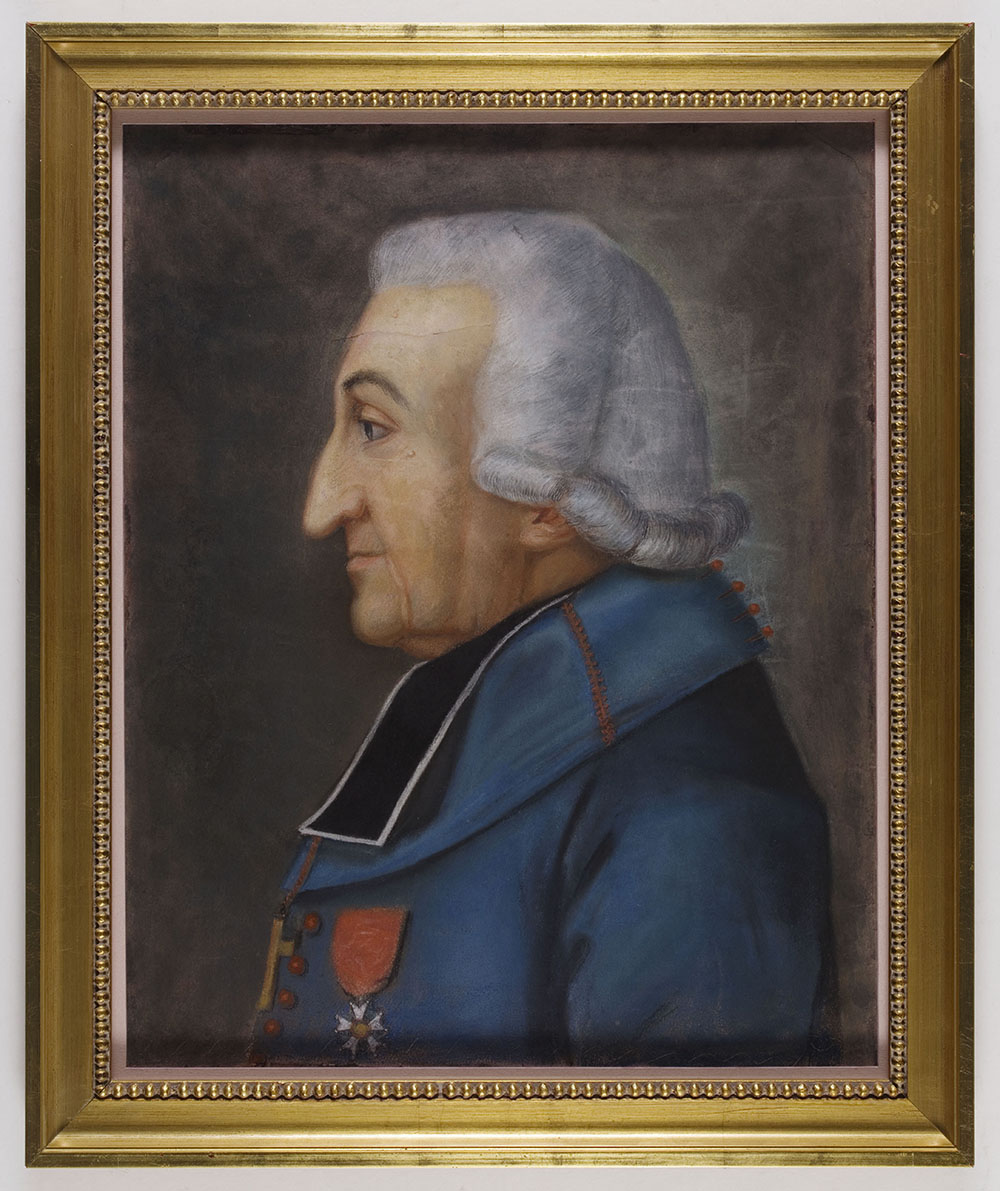
Once I learned that the Haitian government had granted money to L. Rigaud, I knew to look through governmental records collected and published by Haitian historians. Since the time of Haitian independence, Haiti’s writers, journalists, historians, politicians, teachers, and other intellectuals, have displayed diligent concern with and devotion to preserving Haiti’s government records in printed books, an astute method of increasing public access and ensuring preservation of institutional archives in a country with a history of revolution and catastrophic fires, earthquakes, and floods. In volume two of Joseph Justin’s 1895 edition of Études sur les institutions haïtiennes (“study of Haitian institutions”), there was indeed a reference to compensation Rigaud received from the Haitian government for the two paintings. The entry also revealed the first name of the artist referred to in Le Moniteur variously as “citizen Rigaud,” “Mr. Rigaud,” and “L. Rigaud”: “For two paintings by Lafargue Rigaud, artist...1800 [gourdes].”
My mind was fully blown. Were contemporary researchers unable to unearth any biographical information about L. Rigaud because they had his name wrong all along? Or was Lafargue Rigaud possibly another artist who painted Haitian presidents and signed his artwork L. Rigaud? The latter seemed unlikely, but I could not entirely rule it out.
Now that I had a forename, and a rather unique one at that, I could do a deeper search for identifying information related to Lafargue Rigaud in Haiti’s État Civil. Using records digitized by the Association de Généalogie d’Haïti, based in Montréal—which has the third largest Haitian population in North America—and FamilySearch.Org, a project of the Church of Jesus Christ of Latter-Day Saints, I eventually found Lafargue Rigaud’s birth and death records.
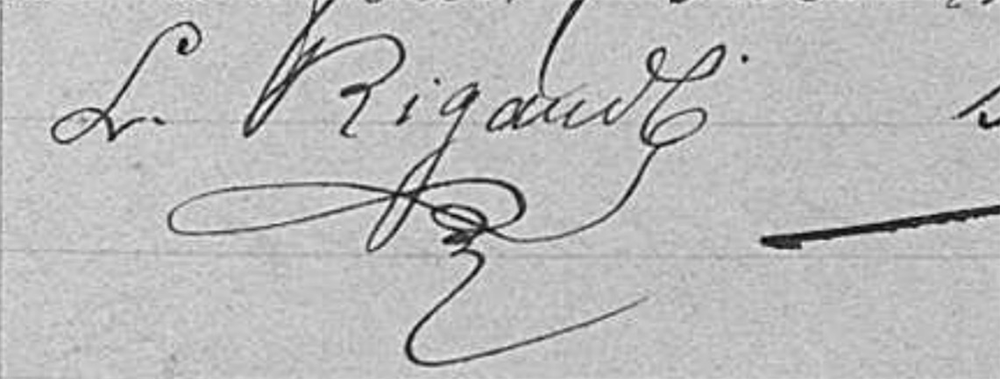
The birth notation in the AGH’s database lists one Faustin Lafarque [sic] Rigaud, born at 8:30 a.m. in Port-au-Prince on June 28, 1847. Although this Rigaud’s parents were not married, both of their names are listed on the act. His father was Auguste Rigaud, a “member of the Chambre des comptes” (chamber of auditors) who had been made a baron by the president turned emperor Faustin Soulouque (after whom Auguste Rigaud perhaps named his son!), while his mother was Marie Olivie Émilie Lafargue, “propriétaire,” or landowner. According to the death record, as photographed by FamilySearch, Faustin Lafargue Rigaud died at 6:00 p.m. on Friday, June 3, 1910, at the age of 63 years, putting his date of birth in 1847, the same as on the birth record. Further records in the État Civil confirm that Faustin Lafargue Rigaud, who lived on rue de la Révolution in Port-au-Prince,2 was a “peintre (artiste)” married to a woman named Marie-Catherine Clitie (also spelled Clysie) Grenier, with whom he had at least two children. His son, Pierre Barthélémy Auguste Lafargue Rigaud, was a medical doctor. His daughter, Marie Madeleine Maria Rigaud, was a modiste who wed at 10:00 a.m. on June 3, 1910, only a few hours before her father’s untimely death from a fall. The signatures on the birth and marriage records for Faustin Lafargue Rigaud’s children (signed L. Rigaud in two instances and simply Rigaud in the other) match those on the paintings in the Peabody’s collection. These details allowed me to confirm that the “artist painter” Faustin Lafargue Rigaud was the same person with that name on the birth and death records, and that he was also the same Lafargue Rigaud who signed the Peabody paintings and received numerous government subsidies for his patriotic artistry of various genres in the nineteenth century.3

Additional reporting in Le Moniteur specifies that in 1888, L. Rigaud had received a payment of 640 gourdes for the “construction of a pavilion bearing the emblem of the Republic, intended for the Palace of the Senate.” He received another 300 gourdes, on April 23, 1889, for “four flags bearing the arms of the Republic sold to the government.” In 1891, another article in Le Moniteur reported that Lafargue Rigaud, “painter-decorator,” and Théracin Pierre, “architect,” had the previous year erected an “arc de triomphe” in the town of Petit-Goâve, in homage to Haiti’s recently deceased president, General Florvil Hyppolite. The “very artistic” edifice, which featured a bust of President Hyppolite, was evidently quite impressive and in-step with Rigaud’s other known creations. Yet judging from the funeral notice published in Le Nouvelliste the day after his death, which acknowledged that his “gallery of heads of state” still hung in the Haitian National Palace’s “grande chambre du conseil,” Lafargue Rigaud’s principal claim to fame remained as a portraitist of Haitian leaders.
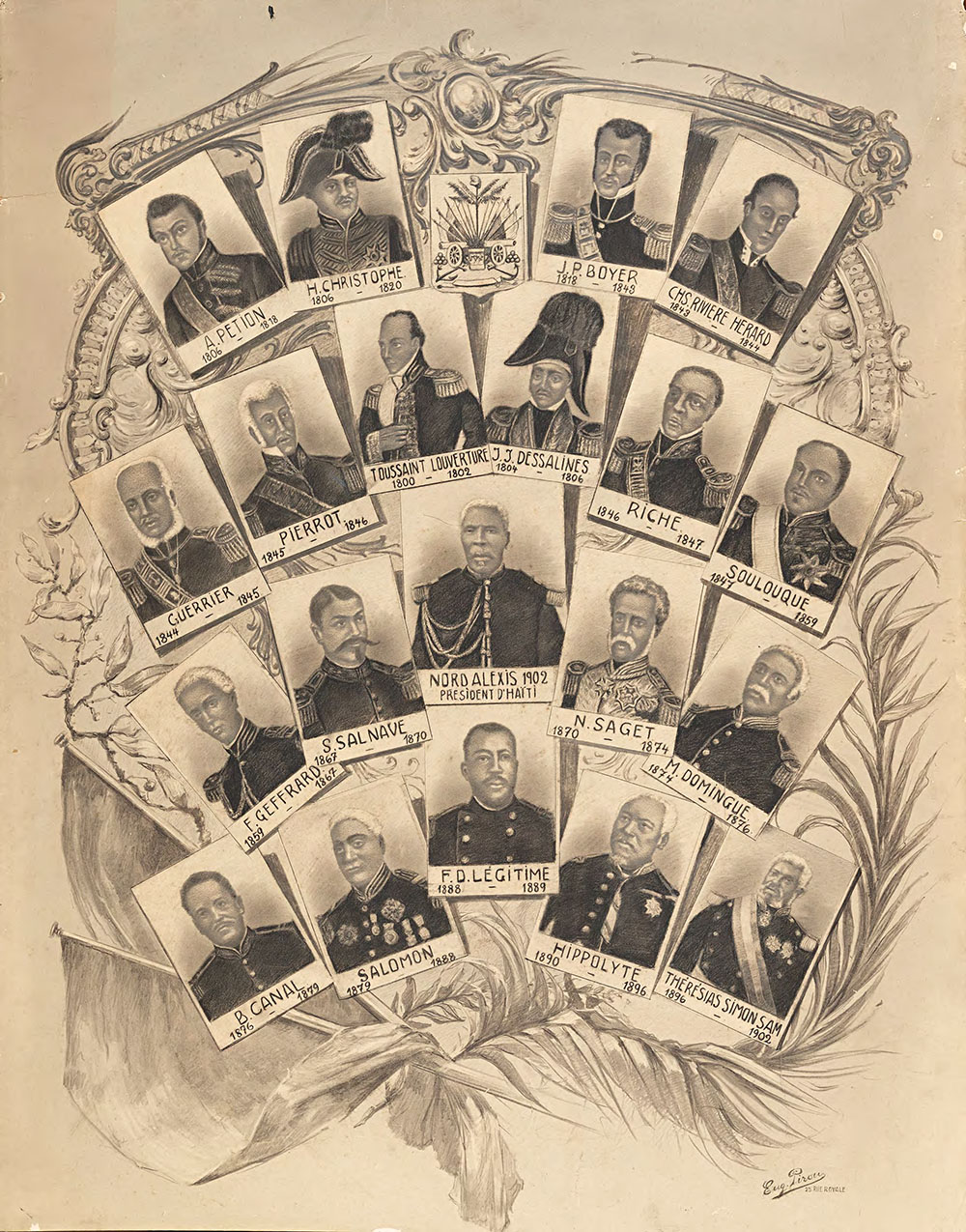
This new information about L. Rigaud’s identity provides clues that may link him to other known collaborators, including members of the Audain family. Such a link would be particularly important since it was the woman known to the wider world only as Madame J.J. Audain (née Marie-Anne Joséphine Laforest) who is presumed to have facilitated the transportation of the seventeen portraits signed by L. Rigaud to the U.S. for display at the World’s Industrial and Cotton Centennial Exposition.
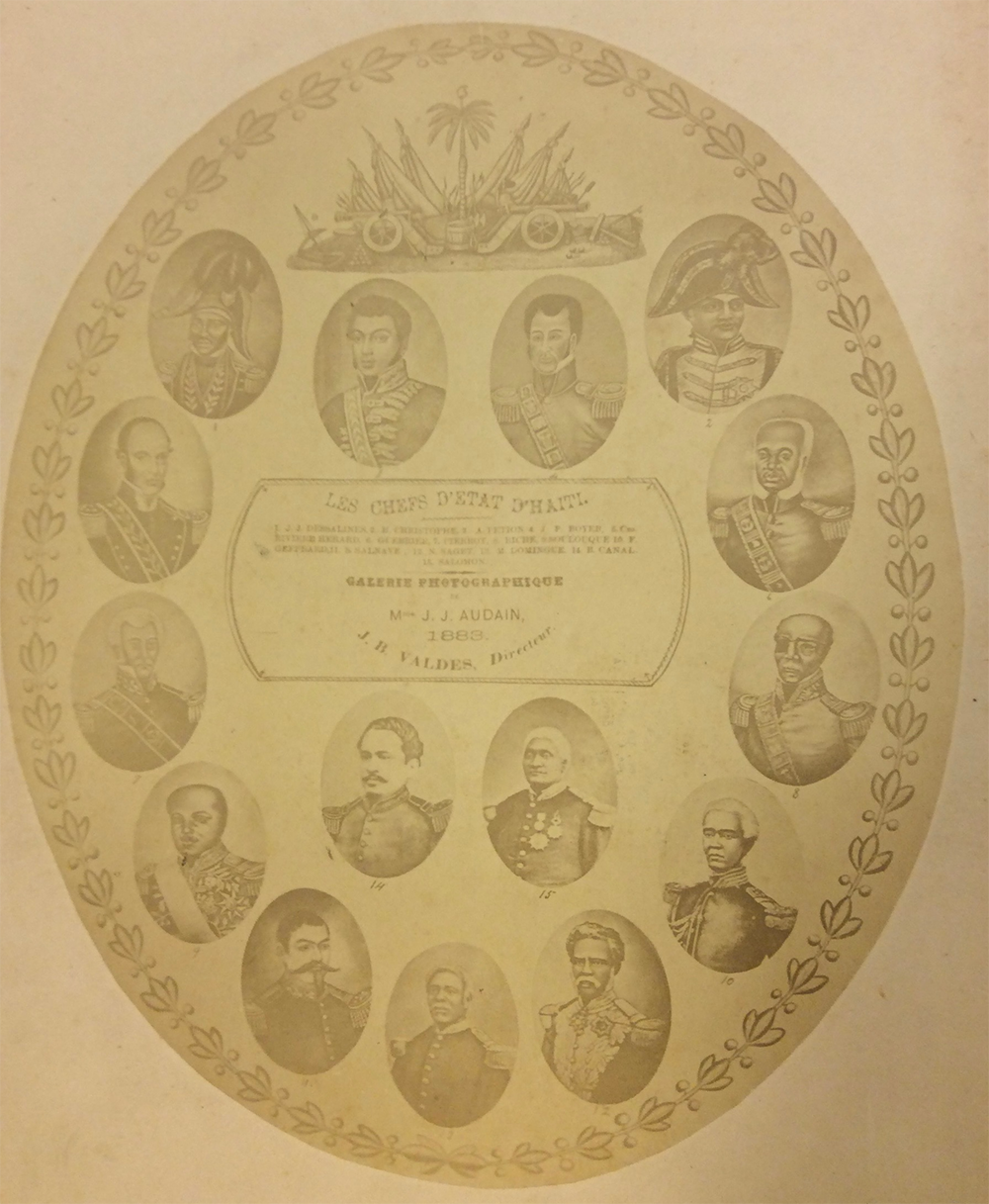
The Rigaud paintings in the Peabody’s collection clearly resemble (but are not identical to) the suite of “photographic” images of Haitian leaders issued by Audain’s gallery in 1883, as well as several engravings in Dantès Fortunat’s Nouvelle géographie de l’île d'Haïti: contenant des notions historiques et topographiques sur les autres Antilles (1888). It is quite likely that these engravings and photographs were derived from the Rigaud head-of-state paintings that, having once hung in the National Palace, were destroyed in the August 1912 explosion that completely obliterated the structure, claiming the lives of more than 60 people, including Haitian president Cincinnatus Leconte.4
There remain many questions to be answered and much more to uncover about the biography, artwork, motivations, and inner circle of the artist who signed his name as L. Rigaud. But Rigaud’s link to the first name Lafargue has already yielded rich information about his connection to Haitian portraiture and his own attempts at its preservation. In 1888, a fire that struck Port-au-Prince severely damaged the Palace of the Senate and the Chamber of Deputies, both of which reportedly had on display numerous “artistic treasures.” Yet a painting of the abolitionist senator Charles Sumner, who spearheaded the official U.S. recognition of Haiti in 1862, evidently survived. While fellow artist and teacher at the National School of Design and Painting, Archibald Lochard, eventually repaired the portrait at the government’s behest, it was Lafargue Rigaud, who, according to an article in Le Moniteur, had submitted the petition for its restoration in 1898.5
Even though Lerebours seems to have accidentally introduced an error into the historical record, at the same time, if we remember and can glimpse any of these early Haitian paintings and their painters, it is in no small part due to Lerebours and Montas’ 1980 exhibit. The paintings in the show had evidently been in such a “deplorable” state that to make them suitable for public viewing, Montas and Lerebours first needed to have them repaired and restored. “This exhibition might never have reached its current scale without the meticulous restoration work—veritable surgery—carried out with the patience of a Benedictine monk…by the artist and painter Bernard Wah,” said journalist Wébert Lahens in his December 1980 review of the exhibit for Le Nouvelliste. Wah’s successful conservation and restoration of the paintings provided seemingly endless subjects of inquiry for Lerebours, who went on to publish multiple books and articles about these early paintings that can and should be considered crucial parts of Haiti’s art historical archives. The two special issues of Conjonction devoted to the topic of nineteenth-century Haitian art, inspired by the 1980 exhibit Lerebours co-curated, and Lerebours’ 1989 book, derived from his doctoral thesis, alone feature dozens of photographs of nineteenth-century Haitian paintings, some of which are now considered lost, destroyed, or of otherwise unknown whereabouts.
This collective work of remembrance, along with Lerebours’ determination to explore, study, and celebrate the persistence of nineteenth- and early twentieth-century Haitian art, definitively defeated the American writer Selden Rodman’s infamous thesis in The Miracle of Haitian Art (1974) that Haiti had no real art until 1944, when the American painter DeWitt Peters founded the Centre d’Art in Port-au-Prince. Montas had opened the November 1980 roundtable by referencing Rodman’s inconceivable claim in his 1948 book, Renaissance in Haiti, that “no painting of any value was known to have originated in the Republic of Haiti since its inception in 1804.” In his own remarks, Lerebours not only highlighted the distinctive flourishing of Haitian art in the nineteenth century but also pointed out that “the founders of the nation…from the very first days following the Proclamation of Independence and despite the difficulties they faced, established a kind of patronage for the benefit of painters.” In Lerebours’ words, Haiti’s founders “well understood” that “truly, paintings sometimes tell us much more about the past than any book.” Lerebours further insisted that since the beginning of Haiti’s existence, art had always complemented and even completed history. “A people’s worth can be measured by their cultural heritage,” he announced. “That’s why the past interests us so much”:
For, in order to bear witness, to faithfully preserve memory, art does not have to reinvent, but to preserve…[Art] can do even do more; it can fill in gaps, it can give free rein to the imagination, reinvent faces obliterated by time and gestures already buried in the depths of collective memory.
The story of how I filled in some of the gaps about L. Rigaud’s identity and ultimately learned his name is not the report of a research travesty. It is testament to the indomitable drive of Haitian intellectuals to preserve, excavate, and reveal. I hope by recovering the history of this particular nineteenth-century Haitian painter, gleaned entirely from Haitian historical records, that I am merely continuing along the intellectual path charted by so many of my forebears.
1 Although women presented at the conference and contributed to the Conjonction special issues, all the artwork was by men. This included a few portraits by contemporary painters, Pierre Augustin, Ulrick Jean-Pierre, and Casimir Joseph, commissioned by Michèle Montas to, in the words of Conjonction contributor Béatrice Duprat, “fill in certain glaring gaps that disrupted the chronological order of the exhibition.” ↩
2 Perhaps, Rigaud was a member of Messieurs Ferdinand Pilot et Compagnie, which operated an artistic studio for hire on rue de la Révolution, circa March 1884, according to an ad in the Haitian newspaper L’Oeil. A real estate notice in the Haitian newspaper Le Matin reveals an additional address for Lafargue Rigaud near the rue Roux and the rue du Peuple in Port-au-Prince, much later in 1909. At the time of his death in June 1910, according to the death notice, Lafargue Rigaud was evidently living on the rue du Magasin de l’État. ↩
3 Although no cause of death was listed on the death certificate, according to Le Nouvelliste, Lafargue Rigaud, who signed as a witness to the recording of his daughter’s marriage only a few hours earlier, passed away suddenly after a fall on the evening of June 3, 1910; Le Moniteur belatedly reported that same day as well that on August 27, 1909, Lafargue Rigaud had been granted a “subvention” from the senate in the amount of 60 gourdes. ↩
4 Presumably referencing Rigaud’s portrait gallery of Haitian leaders, but without naming him as the artist, Le Matin reported the destruction of the paintings with distinct lamentation: “An entire historical past collapsed with the [president] […] In the Salle du Conseil, they were all lined up, those who, in turn, had the perilous honor of guiding the destinies of the Haitian nation, from Toussaint Louverture, rightly named the precursor of independence, to Antoine Simon.” ↩
5 A nineteenth-century painting of Sumner is currently on display at the Musée du Panthéon National Haïtien in Port-au-Prince. ↩